
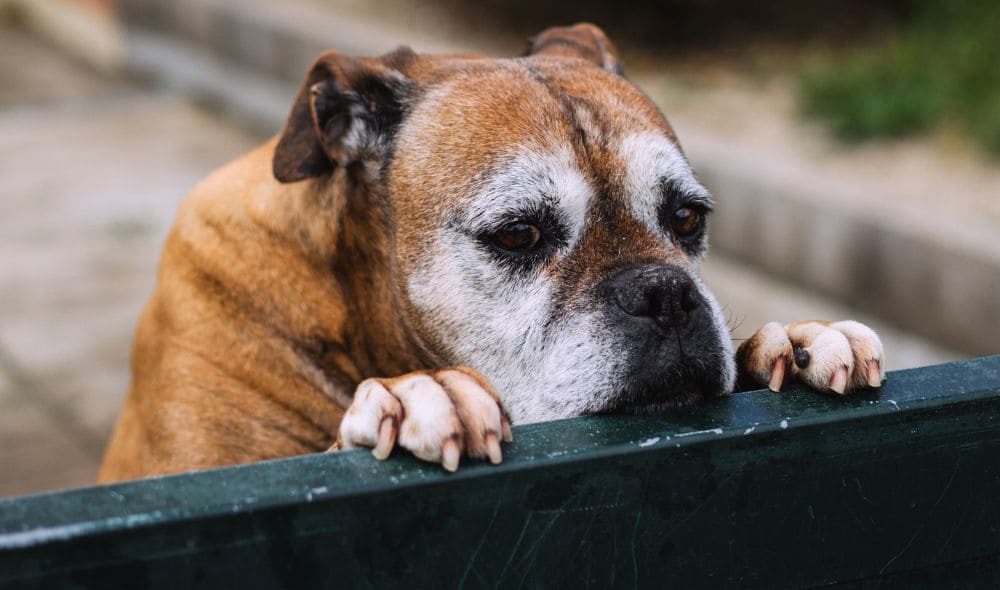
Your old dog stares at a wall for no reason. They wander into a room and seem to forget why. They stand at the wrong side of the door, waiting for it to open. At 2 a.m., they’re pacing and whining instead of sleeping.
If this sounds familiar, you’re not imagining it, and you’re not alone. What you’re likely seeing are the signs of dog dementia — a real, well-documented condition that affects a huge number of senior dogs.
It has a clinical name: canine cognitive dysfunction, or CCD. It shares a lot in common with human dementia, right down to some of the same brain changes. And like human dementia, it’s often misunderstood, underdiagnosed, and mistaken for “just getting old.”
This guide walks through the early signs of dog dementia in senior dogs, what’s actually happening in their brain, and — most importantly — what you can do to help your dog feel more comfortable.
How Common Is Dog Dementia, Really?
More common than most owners realize.
Research suggests that around 28% of dogs between 11 and 12 years old show at least one sign of cognitive dysfunction, and that number climbs to roughly 68% in dogs aged 15 to 16.
Here’s the part that matters most: most cases go undiagnosed. Owners often notice the signs but chalk them up to normal aging, or don’t realize the behaviors are connected to each other. Vets sometimes miss it too, unless an owner specifically describes what’s happening at home — because dogs don’t show cognitive symptoms during a 15-minute exam room visit the way they do in familiar surroundings.
What’s Actually Happening in Your Dog’s Brain
When studying the signs of dog dementia in senior dogs, researchers found that canine cognitive dysfunction shares real biological similarities with Alzheimer’s disease in humans.
As dogs age, a protein called beta-amyloid can build up in the brain, forming plaques that interfere with normal brain function. Blood flow to the brain also tends to decrease with age, and the brain itself can shrink slightly — all of which affects memory, learning, awareness, and sleep regulation.
This isn’t a behavior problem. It’s a physical, structural change happening in your dog’s brain. Understanding that matters, because it changes how you respond — with patience and support rather than frustration or correction.
Signs of Dog Dementia in Senior Dogs
Vets often use the acronym DISHA to describe the core categories of signs of dog dementia in senior dogs. It’s a genuinely useful framework for understanding what you might be seeing.
D — Disorientation
This is often the first and most noticeable sign.
- Staring blankly at walls or into empty space
- Getting “stuck” in corners or behind furniture, unable to figure out how to get out
- Standing at the hinge side of a door instead of the opening side
- Wandering into rooms and seeming to forget why they went there
- Appearing lost in a home they’ve lived in for years
I — Interaction Changes
Your dog’s relationship with you and other pets may shift.
- Seeming less interested in affection, or conversely, becoming unusually clingy
- Reduced greeting behavior — not coming to the door when you get home
- Increased irritability with other pets or family members
- Seeming distant or “checked out” during interactions that used to get an excited response
S — Sleep-Wake Cycle Changes
This is often what pushes owners to finally search for answers, because it affects everyone in the house.
- Sleeping much more during the day
- Restlessness, pacing, or whining at night ” This kind of nighttime restlessness can also come from joint pain rather than cognitive changes — it’s worth ruling out physical discomfort first. “
- Vocalizing (barking or howling) at odd hours for no clear reason
- Reversed day/night patterns — essentially wide awake when the household is trying to sleep
H — House Soiling
A dog who was reliably house-trained for years suddenly having accidents indoors is one of the most distressing signs for owners, and one of the clearest signs of cognitive decline (once medical causes are ruled out — more on that below).
- Forgetting to signal that they need to go outside
- Having accidents shortly after being let outside, as though they forgot the trip’s purpose
- Loss of previously reliable house-training with no other explanation
A — Activity Level Changes
- Reduced interest in play, walks, or previously loved activities
- Repetitive behaviors — pacing in circles, licking the same spot, or other compulsive-looking movements
- Decreased responsiveness to their name or familiar commands
- Occasionally, increased anxious pacing or restlessness during the day
Important: Rule Out Other Causes First
Before assuming your dog has cognitive decline, it is crucial to accurately recognize the signs of dog dementia in senior dogs and distinguish them from medical issues like UTIs or pain.
Here’s something that genuinely matters before assuming it’s dementia: several of these signs — especially house soiling, increased vocalizing, and nighttime restlessness — can also be caused by things that are treatable and unrelated to cognitive decline.
Before settling on a CCD diagnosis, a vet visit should rule out:
- Urinary tract infections (a very common cause of sudden house soiling in senior dogs)
- Pain from arthritis or other joint issues (can cause restlessness, especially at night)
- Vision or hearing loss (can look like disorientation but has a different underlying cause)
- Other medical conditions like thyroid issues, diabetes, or kidney disease, which can all cause behavior changes
This isn’t just a technicality. Some of these conditions are far more treatable than cognitive dysfunction, and mistaking one for the other means missing a chance to actually fix the problem. A proper vet workup — including bloodwork and a physical exam — is the right first step, not a guess based on symptoms alone.
How to Help a Dog With Dementia
When managing the signs of dog dementia in senior dogs, there is no cure, but there is genuinely a lot you can do to slow its progression and make your dog more comfortable.
Keep a Predictable Routine
Consistency helps reduce confusion. Keep feeding times, walk times, and bedtime as consistent as possible. Dogs with cognitive changes often do better with a world that stays predictable, even as their internal experience of it becomes less clear.
Make Nighttime Easier
Since sleep disruption is one of the hardest parts for both dogs and owners:
- Leave a nightlight on in areas your dog frequents, since disorientation is often worse in the dark
- Consider a consistent bedtime routine A supportive, comfortable sleeping surface also matters here — a dog who’s physically comfortable tends to settle more easily, even with cognitive changes to help signal that it’s time to settle
- Some owners find that a later, calming walk before bed helps some dogs settle more easily
- If nighttime restlessness is severe, talk to your vet about medication options — there are treatments that can genuinely help
Support Their Brain with Mental Enrichment
Just like in humans, mental stimulation appears to help slow cognitive decline in dogs.
- Puzzle feeders and food-dispensing toys that require some problem-solving
- Short, gentle training sessions revisiting basic commands your dog already knows (success feels good, even with a foggy brain)
- New, low-stress sniffing opportunities on walks — scent work is mentally engaging and doesn’t require sharp memory or vision
- Gentle, short play sessions rather than long or overstimulating ones
Make Their Environment Safer
- Block off stairs if disorientation makes them a fall risk
- Use baby gates to limit access to areas where your dog might get “stuck” or confused
- Keep furniture arrangement consistent — moving things around can increase disorientation in a dog relying on spatial memory
- Add nightlights along common paths (bedroom to water bowl, for example)
Ask Your Vet About Medication and Supplements
There are prescription medications specifically approved for managing canine cognitive dysfunction, along with supplements that show promise:
- Selegiline is an FDA-approved medication specifically for CCD in dogs
- SAMe and certain antioxidant blends have some supporting research for cognitive support
- Omega-3 fatty acids may help support overall brain health Omega-3s are also one of the most well-researched ingredients in joint supplements for senior dogs — supporting both brain and joint health as dogs age.
None of these should be started without your vet’s guidance, but it’s worth having the conversation — there are more options available now than most owners realize.
Be Patient With House Training Regression
This is often the hardest part emotionally. Your dog isn’t being difficult or “forgetting their training” out of stubbornness — their brain is genuinely struggling to process signals it used to handle automatically.
More frequent outdoor trips, a consistent potty schedule, and washable, protective bedding can help manage this practically while reducing frustration for everyone.
Taking Care of Yourself Too
Coping with the signs of dog dementia in senior dogs and watching a pet you love change like this is genuinely hard. It can feel like grief happening in slow motion, even while your dog is still right there with you.
That’s a normal response, not an overreaction. Many owners describe this stage as one of the emotionally hardest parts of having a senior dog — harder, in some ways, than physical decline, because the dog’s personality itself seems to be shifting.
Give yourself permission to grieve the parts that are changing, while still finding the moments — and there usually still are moments — where your dog is present, comfortable, and connected with you.
Frequently Asked Questions
At what age do dogs typically start showing signs of dementia? Signs can begin as early as 9–10 years old in some dogs, though it becomes significantly more common from age 11 onward. Large and giant breeds, which age faster overall, sometimes show signs a bit earlier than smaller breeds.
Is dog dementia the same as Alzheimer’s disease? It’s not identical, but there are real biological similarities — including the buildup of beta-amyloid protein in the brain, which is also a hallmark of Alzheimer’s in humans. This is part of why dogs with CCD are sometimes studied as a model for understanding human Alzheimer’s research.
Can dog dementia be reversed? No, canine cognitive dysfunction is progressive and currently can’t be reversed. However, early intervention with medication, environmental changes, and mental enrichment can meaningfully slow progression and improve quality of life for a significant period of time.
How do I know if it’s dementia or just normal aging? Normal aging involves some slowing down, but not the specific patterns described by DISHA — significant disorientation, house-training breakdown, or genuine confusion in familiar spaces. Noticing distinct signs of dog dementia in senior dogs — such as severe disorientation and lost house-training — means it is time to consult your vet rather than assuming it’s typical aging.
Should I be worried if my senior dog suddenly has house-training accidents? It’s worth investigating rather than worrying alone. Sudden house soiling has several possible causes, including urinary tract infections, which are very treatable. A vet visit is the right next step to figure out what’s actually going on.
Is it kinder to let a dog with dementia live out their life at home, or is euthanasia ever the right call? This is one of the hardest questions a senior dog owner can face, and there’s no universal answer. Quality of life — not the diagnosis itself — should guide the decision. Many dogs with cognitive dysfunction live comfortably for years with the right support. If you’re struggling with this question, a conversation with your vet about your specific dog’s quality of life indicators can help you feel more confident in whatever you decide.
This article is for general informational purposes and is not a substitute for professional veterinary advice. If your dog is showing any signs of illness, pain, or health concerns, please consult your veterinarian for a proper diagnosis. See our Medical Disclaimer for more information.
PawzyVibe participates in the Amazon Services LLC Associates Program. If you purchase through links on this page, we may earn a small commission at no extra cost to you. We only recommend products we genuinely believe help senior dogs.