
Last updated: October 2026
Your house probably hasn’t changed in years. Your dog has. That gap is where most senior dog injuries actually happen — not on a hiking trail, but on the same kitchen floor they’ve crossed ten thousand times before.
Senior dog home safety isn’t about turning your living room into a padded cell. It’s a handful of targeted changes, room by room, that account for weaker joints, foggier vision, and slower reflexes.
This guide walks through exactly where to focus, starting with the hazard most owners never think twice about.
Why Your Home Gets Riskier as Your Dog Ages
A dog who used to launch off the couch without a second thought now hesitates at the edge, front paws planted, back legs unsure. That hesitation is information.
Declining vision, hearing loss, joint pain, and even early cognitive changes all chip away at a dog’s ability to navigate a space they used to know by heart. None of these show up as one dramatic moment. They show up as a hundred small stumbles you might not even connect to each other. Recognizing that pattern early is really what senior dog home safety comes down to — catching small changes before they turn into a fall.
💡 Vet Technician Note: If your dog has started avoiding a specific room, staircase, or piece of furniture they used to use freely, don’t assume it’s stubbornness. Pain, poor traction, or vision changes are far more likely explanations — and worth mentioning at their next checkup.
Flooring: The Hazard Almost Everyone Overlooks
Hardwood, tile, laminate — the exact floors that look great in photos are genuinely dangerous for a dog with weakening hips or arthritis. Every slip forces stabilizing muscles to overcorrect, and repeated micro-slips add up to real joint stress over time.
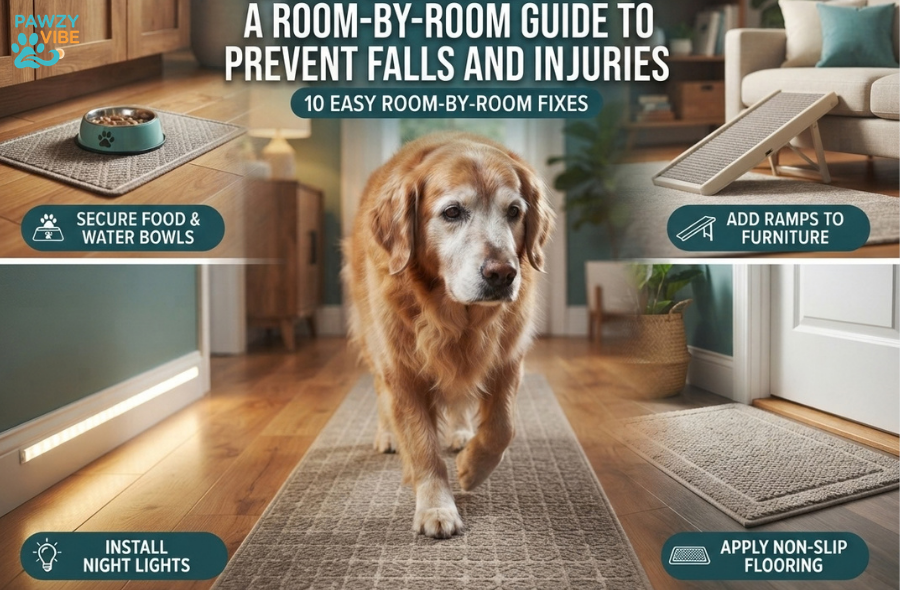
Rugs and runners along your dog’s main routes — kitchen to back door, bedroom to living room — solve most of this instantly. Rubber-backed mats work even better since they won’t bunch or slide.
For dogs who need more consistent traction throughout the day, non-slip socks give grip on every hard surface in the house, not just the rooms you’ve rugged. Flooring fixes alone solve a surprising share of senior dog home safety concerns, which is exactly why they’re worth tackling first.
Room-by-Room Safety Checklist
Walking through senior dog home safety one room at a time makes the whole project feel far less overwhelming than trying to fix everything at once.
Living Room
Furniture height matters more than people realize. If your dog is hesitating before jumping onto the couch, that hesitation is a warning sign worth listening to, not a habit to push through.
A supportive orthopedic dog bed placed at floor level gives your dog a comfortable spot that doesn’t require any jumping at all. It’s a small change, but it’s one of the easiest senior dog home safety wins in the entire house.
Stairs and Entryways
Stairs are one of the biggest fall risks in the whole house, especially for dogs managing joint pain or early mobility loss. A well-placed dog ramp at the front steps or a favorite piece of furniture removes the jump entirely.
For dogs who still need to navigate stairs occasionally, a support harness with a handle lets you assist without either of you straining.
Bedroom
Keep a nightlight running if your dog’s vision has started to decline — for a dog dealing with vision loss, a dark room at 3 a.m. is a genuine obstacle course.
Consistency matters here too. Moving furniture around, even slightly, can throw off a dog who’s learned to navigate mostly by memory rather than sight. Keeping this room predictable is a quiet but genuinely important part of senior dog home safety.
Kitchen and Dining Areas
This is usually the worst flooring in the house and the room your dog crosses most often. A rubber-backed runner from the doorway to the food bowl handles a huge share of daily slip risk in one move.
Raised food and water bowls can also help dogs with neck or joint stiffness avoid an awkward, repeated bend several times a day.
Bathroom and Laundry Areas
If accidents have become more frequent, washable pads and easy-clean flooring in one designated spot save you a lot of frustration. It’s worth pairing this with a broader conversation about the cause if it’s a new pattern.
Yard and Outdoor Access
A single step down to the yard can be just as risky as a full staircase. Outdoor ramps and secure, well-lit paths matter here too, especially for dogs going out after dark. Outdoor spaces are easy to overlook, but they deserve the same senior dog home safety attention as anything indoors.
Rounding Out Your Mobility Toolkit
A big part of senior dog home safety comes down to having a small set of products on hand and actually using them consistently, rather than buying one thing after a scare and stopping there. A handful of products cover most of what’s discussed above, and they work best in combination rather than picked one at a time:
- Dog ramps for stairs, cars, and furniture
- Support harnesses for hands-on assistance
- Non-slip socks for everyday traction
- Orthopedic beds for pressure relief and easy access
💡 Vet Technician Note: You don’t need every product on this list on day one. Start with whatever room causes the most visible struggle, and build out from there as things change.
A Real-Life Scenario
After her 12-year-old Lab, Bear, slipped on the kitchen tile and yelped hard enough to scare her half to death, Priya spent one weekend adding rugs down every hallway and a ramp by the back door. She half-expected it to be overkill. Instead, Bear started moving through the house with a confidence she hadn’t seen in over a year.
Senior Dog Home Safety Checklist
| If You Notice… | Do This |
|---|---|
| Slipping on hardwood, tile, or laminate | Add rugs or rubber-backed runners along main routes |
| Hesitating before jumping on furniture or into the car | Add a ramp instead of expecting them to keep jumping |
| Struggling with stairs | Add a ramp, or use a harness with a handle for assistance |
| Bumping into furniture, especially at night | Add nightlights and keep furniture layout consistent |
| Frequent accidents indoors | Set up a washable, easy-clean zone near an exit |
| General new hesitation anywhere in the house | Mention it at your dog’s next vet visit — it’s usually meaningful |
Frequently Asked Questions
What’s the best place to start with senior dog home safety? Addressing slippery flooring along your dog’s main routes usually has the biggest impact, since hard floors are one of the most common and preventable fall risks in the house.
Do senior dogs really need ramps if they can still jump? If jumping is starting to look hesitant or effortful, a ramp prevents unnecessary joint strain even before a dog fully loses the ability to jump on their own.
How can I help a senior dog with vision loss navigate the house safely? Keep furniture layout consistent, add nightlights for darker hours, and avoid rearranging rooms your dog has learned to move through mostly from memory.
Is it too late to senior-proof my home if my dog is already having accidents or falls? Not at all. Even a few targeted changes — rugs, a ramp, better lighting — can meaningfully reduce risk starting immediately.
How do I know which room to fix first? Start with whichever room causes the most visible struggle or the most falls, then work outward from there as your dog’s needs change.
Medical Disclaimer: This article is intended for informational purposes only and is not a substitute for professional veterinary advice. If your dog is having frequent falls, sudden mobility changes, or new hesitation getting around the house, please consult a veterinarian to rule out an underlying medical cause.
Amazon Affiliate Disclosure: PawzyVibe is a participant in the Amazon Services LLC Associates Program, an affiliate advertising program designed to provide a means for sites to earn advertising fees by advertising and linking to Amazon.com. As an Amazon Associate, we earn from qualifying purchases at no additional cost to you.