
Last updated: September 2026
If your senior dog has started stumbling over their own back paws, dragging a toenail across the floor, or struggling to push themselves up after a nap, your first instinct is probably arthritis. That’s a fair guess — but it isn’t always the right one.
Degenerative myelopathy in senior dogs is a progressive spinal cord disease that mimics arthritis in its early stages, then quietly diverges into something far more serious. It’s not painful in the way arthritis is, but it is relentless, and it eventually takes away a dog’s ability to walk.
This guide walks you through the early warning signs, the four clinical stages, how vets tell it apart from arthritis, and — most importantly — how to keep your dog comfortable, mobile, and dignified for as long as possible.
What Is Degenerative Myelopathy in Senior Dogs?
Degenerative myelopathy (DM) is a slow, progressive disease of the spinal cord. It causes progressive muscle weakness and loss of coordination in dogs, acting similarly to Lou Gehrig’s disease (ALS) in humans.
As the protective insulation around spinal nerve fibers breaks down, signals between the brain and the hind legs get weaker and weaker. The dog isn’t in pain from this process itself — they’re simply losing the ability to feel and control their back end.
DM most often affects German Shepherds, Chesapeake Bay Retrievers, Rhodesian Ridgebacks, Boxers, Corgis, and Standard Poodles, though it can occur in other breeds and mixed-breed dogs too. Onset typically happens between 8 and 12 years old, which is exactly why DM so often gets lumped in with “normal senior slowdown” or arthritis at first.
💡 Vet Technician Note: If your senior dog’s hind-end weakness doesn’t respond to arthritis pain medication the way you’d expect, don’t assume the meds “just aren’t working.” That mismatch is often the first real clue pointing away from arthritis and toward something neurological.
Early Warning Signs You Shouldn’t Ignore
DM’s early signs are subtle, and they almost always start in one or both hind legs before spreading. Watch for:
- Knuckling — the top of a back paw drags or folds under while walking, especially when turning
- Scuffed or worn rear toenails from the paw dragging on the ground
- Swaying hindquarters when standing still
- Crossing the back legs while walking
- Difficulty rising from a lying-down position
- Easily toppling over when nudged gently from the side
- A “drunken” or wobbly gait in the back end (ataxia)
Because these signs overlap heavily with arthritis and general signs of pain in senior dogs, many owners spend months treating the wrong condition before a neurological workup uncovers DM.
The Four Stages of Degenerative Myelopathy
Vets and researchers typically describe DM’s progression in four clinical stages. Affected dogs will be wobbly and may knuckle over the paws, cross the hind limbs, or stumble while walking, and as the condition progresses, a severely affected dog will eventually lose the ability to stand on or move the hind limbs at all.
| Stage | What You’ll See | Mobility Level |
|---|---|---|
| Stage 1 | Knuckling, dragging feet, difficulty rising, stumbling in the hind end | Still walks independently |
| Stage 2 | Severe hind-limb weakness | Can’t walk unassisted on back legs |
| Stage 3 | Hind-limb paralysis, weakness spreading to front limbs, muscle wasting, incontinence | Needs a cart or full support |
| Stage 4 | Complete paralysis, breathing and swallowing difficulty | Fully dependent care |
Affected dogs may fully lose the ability to walk anywhere from 6 months to 2 years after the onset of signs, and smaller breeds tend to progress more slowly than larger ones. Every dog’s timeline looks a little different, so try not to anchor too tightly to averages.
Degenerative Myelopathy vs. Arthritis: How Vets Tell the Difference
This is the question that keeps owners up at night, and it’s a genuinely tricky one — because in the early stages, DM and senior dog arthritis can look almost identical from the outside.
Here’s the key distinction vets rely on:
| Feature | Degenerative Myelopathy | Arthritis |
|---|---|---|
| Pain response | Generally not painful on its own | Painful, especially on joint manipulation |
| Response to pain meds | No real improvement | Noticeable improvement |
| Progression pattern | Steady, one-directional decline | Can wax and wane; flares and good days |
| Reflexes | Diminish or disappear over time | Usually remain normal |
| Sensation in paws | Decreases (dog may not “feel” a knuckled paw) | Normal |
A simple test many vets use: gently flip your dog’s back paw over so they’re standing on the top of it. A dog with normal sensation will quickly flip it right-side up. A dog with DM may leave it knuckled under for several seconds, because they genuinely can’t feel it’s wrong.
💡 Vet Technician Note: Never try to diagnose DM at home based on the paw-flip test alone. It’s a useful screening clue, but hip dysplasia, IVDD, and spinal tumors can all produce similar symptoms — only a full neurological exam and imaging can sort out what’s really going on.
Which Breeds Are Most at Risk?
DM has a genetic component. Dogs with two copies of a mutated SOD1 gene are at increased risk of developing the disease, while a dog with just one copy is considered a carrier at lower risk.
Breeds with a documented higher risk include:
- German Shepherd Dogs
- Pembroke Welsh Corgis
- Boxers
- Chesapeake Bay Retrievers
- Rhodesian Ridgebacks
- Bernese Mountain Dogs
- Standard Poodles
A DNA cheek-swab test for the SOD1 mutation is widely available and can flag at-risk dogs. It’s worth noting, though, that carrying the mutation doesn’t guarantee a dog will develop clinical DM — it identifies risk, not certainty.
How Vets Diagnose DM
There’s no single blood test or scan that says “yes, this is DM” while a dog is alive. Definitive diagnosis actually requires spinal cord biopsy, which can only be performed after death, so in practice, vets diagnose DM by ruling everything else out first.
A typical diagnostic workup includes:
- A full physical and neurological exam
- Bloodwork and urinalysis
- X-rays of the spine and hips (to rule out arthritis, hip dysplasia, or tumors)
- Advanced imaging — MRI or CT — to check for disc disease or spinal cord compression
- The SOD1 genetic test, to assess inherited risk
Because x-rays alone can’t visualize the spinal cord itself, an MRI or CT scan is often the only way to get a clear picture of what’s actually happening. Since these scans require your dog to stay completely still, they’re typically done under sedation — so it’s worth reading up on anesthesia in senior dogs beforehand if this step is recommended for your pup.
Is There a Treatment? Managing DM Day to Day
Here’s the honest, hard truth: there is currently no cure for DM, and it can’t be reversed. But that doesn’t mean there’s nothing you can do.
Physical therapy is scientifically proven to slow the clinical progression of DM and keep dogs ambulatory longer than dogs who don’t receive it. A solid management plan usually includes:
- Professional physical therapy — underwater treadmill sessions, massage, and core-strengthening exercises once or twice a week
- Daily at-home exercises your vet or a canine rehab specialist can teach you
- Mobility support — support harnesses with rear-lift handles make it far easier to help your dog up stairs or into the car without straining your own back
- Traction aids — non-slip socks help protect knuckling paws from scraping and give weakening hind legs more grip on hard floors
- Ramps instead of stairs — dog ramps for senior dogs reduce the strain of climbing when hind-leg coordination is unreliable
- Weight management to reduce load on already-weak hindquarters
- Mobility carts (dog wheelchairs) once a dog can no longer support their own hind end, allowing many dogs to keep walking, playing, and enjoying life for months or even years longer
💡 Vet Technician Note: Dogs in later stages of DM spend a lot more time lying down, which puts them at real risk of pressure sores. A supportive, well-padded surface isn’t a luxury at this point — it’s part of the treatment plan. Rotating your dog’s position every few hours matters just as much as the mattress itself.
A Real-Life Scenario
Denise noticed her 9-year-old German Shepherd, Bear, was dragging one back paw on their evening walks. She assumed it was arthritis and started him on joint supplements, but three months later his back legs were swaying so badly he could barely stand at the food bowl. A veterinary neurologist eventually diagnosed DM — and while the news was devastating, a rehab plan and a rear-support harness gave Bear another year and a half of walks, car rides, and tail wags before his hind legs gave out completely.
Supporting Quality of Life Long-Term
As DM progresses into the later stages, incontinence often develops alongside the hind-limb paralysis. If that starts happening, our guide to senior dog incontinence covers washable bedding, belly bands, and skin-care routines that prevent urine scald.
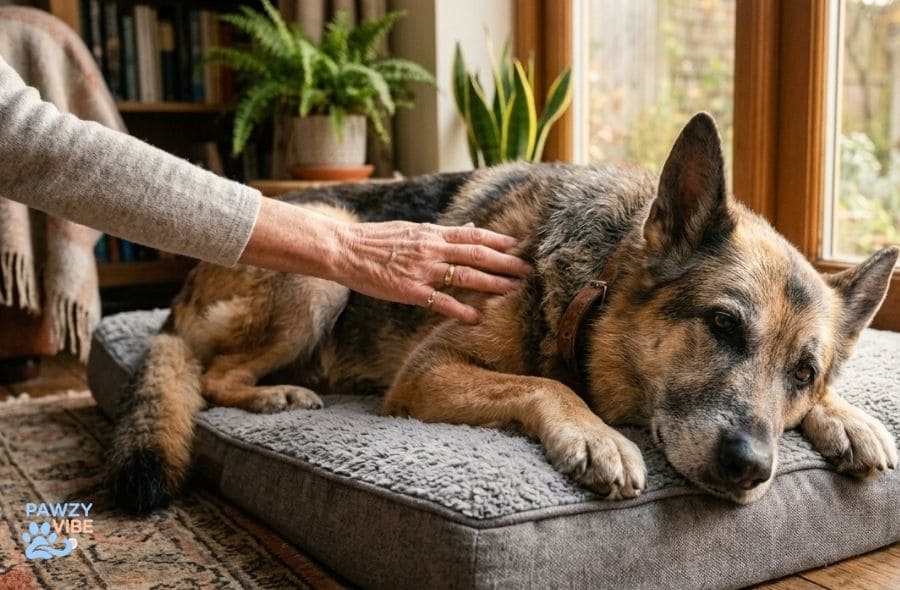
An orthopedic dog bed can also make a real difference for a dog who’s spending more hours resting, by cushioning bony hips and reducing pressure-point sores.
Throughout all of this, your relationship with your vet — and ideally a veterinary neurologist or certified canine rehabilitation therapist — becomes your most valuable resource for adjusting the plan as things change.
Degenerative Myelopathy Action Checklist
| If You Notice… | Do This |
|---|---|
| Knuckling, dragging paws, or hind-end swaying | Book a vet visit — don’t assume it’s “just aging” |
| Pain meds aren’t improving mobility | Ask your vet about a neurological exam |
| At-risk breed (GSD, Corgi, Boxer, etc.) | Ask about the SOD1 genetic test |
| Confirmed or suspected DM | Start physical therapy/rehab as early as possible |
| Dog struggles with stairs or the car | Add a rear-support harness and a ramp |
| Paws scraping on hard floors | Add non-slip socks for traction and paw protection |
| Dog spends more time lying down | Switch to a supportive orthopedic bed and rotate position regularly |
| Hind-limb paralysis develops | Discuss a mobility cart and incontinence management with your vet |
Frequently Asked Questions
Is degenerative myelopathy in dogs painful? Generally, no. Most affected dogs do not seem to be in pain, just very weak. However, the extra strain of compensating with weak hind legs can sometimes cause secondary discomfort in the back, shoulders, or front limbs.
How long can a dog live with degenerative myelopathy? It varies widely by dog and breed size, but many dogs remain able to walk for 6 months to 2 years after signs begin, and some live well beyond that with strong supportive care and mobility aids.
Can degenerative myelopathy be cured or reversed? No. There’s currently no cure, and the disease doesn’t reverse course. Management focuses on slowing progression and maximizing comfort and mobility for as long as possible.
How do I know if my dog has arthritis or degenerative myelopathy? The clearest clue is response to pain medication and pain on exam: arthritis is painful and typically improves with anti-inflammatories, while DM causes weakness without pain and won’t respond to those medications. Only a vet exam and imaging can confirm which one you’re dealing with.
Are dog wheelchairs worth it for degenerative myelopathy? For many dogs, yes. Once hind-limb strength is gone, a properly fitted cart lets dogs keep walking, exploring, and engaging with life — which can meaningfully extend both their quality of life and the time you have together.
Medical Disclaimer: This article is intended for informational purposes only and is not a substitute for professional veterinary diagnosis, advice, or treatment. Degenerative myelopathy shares symptoms with several other serious conditions, so always consult a licensed veterinarian or veterinary neurologist if your dog shows signs of hind-limb weakness.
Amazon Affiliate Disclosure: PawzyVibe is a participant in the Amazon Services LLC Associates Program, an affiliate advertising program designed to provide a means for sites to earn advertising fees by advertising and linking to Amazon.com. As an Amazon Associate, we earn from qualifying purchases at no additional cost to you.